Appfunnel vs FunnelFox: which web2app platform fits your team?
FunnelFox is a proven no-code funnel builder with a large template library and broad payment gateway support. Appfunnel is a plug-n-play funnel builder too, but everything you build is real code underneath, with deeper analytics and pricing that starts at free. Different ceilings for the same job.

$0
to try Appfunnel: 14 days free. Then $199/mo + 2% of proceeds. FunnelFox lists $3,000/mo + 2%.
| Appfunnel | FunnelFox | |
|---|---|---|
| Approach | ||
| Product | Plug-n-play builder, code underneath | No-code funnel builder |
| Visual funnel builder | Yes | Yes |
| Yes | No | |
| Yes | No | |
| Pre-built templates | Growing library | Large library |
| Payments | ||
| Stripe | Yes | Yes |
| Paddle | Yes | Yes |
| Solidgate | Yes | Yes |
| Primer.io | Yes | Yes |
| One-click post-purchase upsells | Yes | Yes |
| Free trials & introductory offers | Yes | Yes |
| Analytics & attribution | ||
| Yes | No | |
| ROAS analytics | Yes | No |
| Yes | No | |
| Conversion funnel visualization | Yes | Partial |
| Meta CAPI (server-side) | Yes | Yes |
| Google Ads server events | Yes | Yes |
| TikTok Events API | Yes | Yes |
| Infrastructure | ||
| Custom domains with SSL | Yes | Yes |
| A/B experiments | Yes | Yes |
| Translate a funnel with AI | All plans | — |
| Webhook delivery with retries | Yes | Yes |
| RevenueCat integration | Yes | Yes |
| Pricing | ||
| $199/mo + 2% of proceeds | $3,000/mo + 2% | |
Competitor pricing and features from public materials at the time of writing. Check funnelfox.com for current terms.
Where point-and-click ends
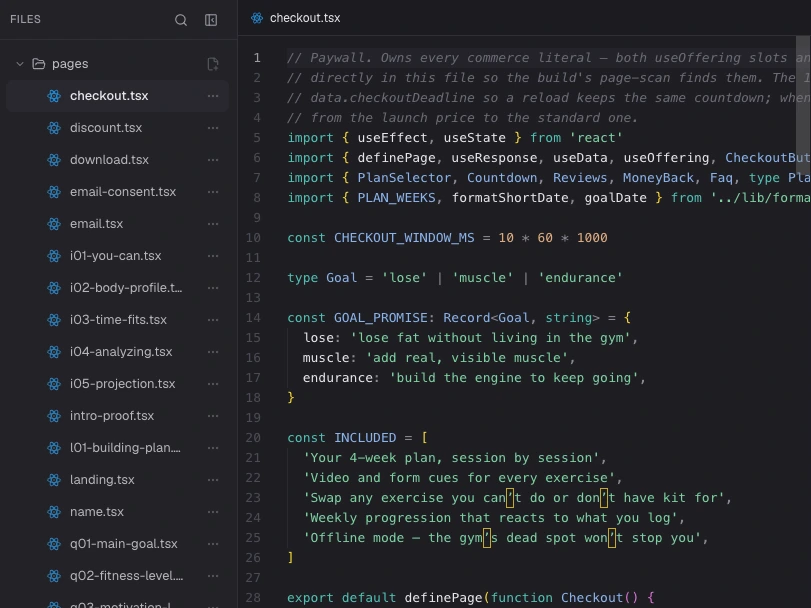
Both platforms start with a visual builder. The difference is what's underneath when you push past the editor.
Components
custom pricing logic?
not exposed by the editor.
request a feature and wait
What the higher ceiling buys you
FunnelFox is a mature no-code builder with more templates and payment gateways. Appfunnel trades template breadth for depth: real code under every funnel, and analytics built for paid acquisition.
Point-and-click first, code when you outgrow it
FunnelFox is a no-code builder: you work within their templates and components, and that is where it ends. Appfunnel starts the same way: build every page visually in the browser with a live preview. But everything you click together is real React code underneath. When point-and-click stops being enough, your engineers or AI agents take the same funnel further.
- Visual builder with live device preview: launch a funnel in an afternoon
- Real code underneath: agents like Claude Code work on funnels over MCP or the CLI
- No migration cliff: the visual funnel and the code funnel are the same funnel
- FunnelFox has the larger template library if you want a purely template-driven workflow
Analytics that actually drive decisions
FunnelFox gives you basic conversion metrics. Appfunnel gives you what a growth team runs on: page-level drop-off, ROAS per campaign, and LTV cohorts that call payback. Median cohort breakeven across funnels on Appfunnel lands around day 90 (our own figure, not an industry one), so you know which campaigns produce profitable subscribers, not just installs.
- Page drop-off analytics: see exactly where users abandon the funnel
- ROAS analytics: connect ad spend to actual subscriber revenue
- LTV cohorts: payback and breakeven per channel and campaign
- Reporting is built on verified payment events, not modeled estimates
Pricing that doesn’t punish starting
FunnelFox lists $3,000/month as a base fee plus 2% of tracked revenue: $36,000 a year before your first conversion. Appfunnel is one flat rate, $199/month plus 2% of proceeds, with a 14-day free trial.
- Growth: $199/month plus 2% of proceeds, every feature included
- At $10k proceeds: Appfunnel $399/mo vs FunnelFox $3,200/mo (listed)
- At $50k proceeds: Appfunnel $1,199/mo vs FunnelFox $4,000/mo (listed)
- Every feature ships on both plans. No tier gates, priced on proceeds not traffic
$ claude "add an annual plan page after the quiz"
agentreading funnel.ts · 6 pages, 2 experiments
agentwriting pages/paywall-annual.tsx
agentwiring quiz → paywall-annual in funnel.ts
preview updated · draft open in the editor
✓ paywall-annual in preview, armed for experiment
Which one fits your team?
Choose FunnelFox if…
- Want a large, ready-made template library with minimal customization
- Prefer a platform with a longer track record
- Already run FunnelFox funnels and the current analytics are enough
Choose Appfunnel if…
- Want to launch visually and keep a code ceiling for engineers or AI agents later
- Need page-level drop-off, ROAS, and LTV analytics tied to real charges
- Want to start with a 14-day free trial, then one flat rate plus 2% of proceeds
- Use Stripe, Paddle, Whop, Solidgate, or Primer.io for payments
Appfunnel vs FunnelFox, answered
Is Appfunnel a direct replacement for FunnelFox?
Yes. Appfunnel covers the same ground: visual funnel builder, web checkout, attribution, A/B experiments. It adds deeper analytics plus a code power ceiling for when you outgrow clicking. Payments are not the dividing line either way — Stripe, Paddle, Whop, Solidgate and Primer.io are all first-class providers on every Appfunnel plan.
Can I migrate my existing FunnelFox funnels to Appfunnel?
There is no automated migration tool, but most teams rebuild a funnel in Appfunnel within a day using the visual builder. Because Appfunnel funnels are real code, an AI agent can also scaffold your funnel from screenshots or a description of your existing FunnelFox flow.
Does Appfunnel work with Solidgate or Primer.io?
Yes, on every plan. Solidgate and Primer.io are first-class payment providers alongside Stripe, Paddle and Whop: you connect the account in store settings and the funnel itself does not change. They are different tools, though — Solidgate is a processor you settle through that also routes across acquirers, while Primer.io is a pure orchestration layer above the processors you already hold.
What does "code power ceiling" actually mean?
Everything you build by clicking in the Appfunnel editor is real React code underneath: the funnel definition, your products, and the page components. Your engineers can work on it like any codebase, and AI agents like Claude Code can pair with the live editor over MCP or ship changes through the CLI. With a no-code-only platform like FunnelFox, the ceiling is whatever the editor exposes.
How does Appfunnel’s analytics compare to FunnelFox’s?
Appfunnel provides page-level drop-off tracking, ROAS analytics, and LTV cohort analysis tied to real charges. FunnelFox’s dashboard shows conversion metrics but doesn’t break down where users abandon the funnel or connect ad spend to subscriber lifetime value.
Is FunnelFox better for teams that don’t code?
Both platforms are built to be used without writing code, and FunnelFox has been around longer with more predefined templates. The difference shows up later: on Appfunnel you have somewhere to go when you outgrow the editor, because the same funnel becomes code your team or your agents can extend. If you are certain you’ll never want that, either works.
Keep comparing
Same job. Higher ceiling.
Built for the funnel you'll run in a year, priced for the one you'll launch this week. Free for 14 days.