You're spending thousands on ads to acquire users, and Apple takes 30% of the revenue they generate. The math doesn't work. But it doesn't have to be this way.
The Problem: Why the 30% Fee Kills Your Margins
Paid acquisition is already expensive. CPIs have risen roughly 30% year over year, and the trend shows no sign of slowing down. After Apple's 30% cut, your margins on each subscriber shrink dramatically.
Let's look at a simple example. A $9.99/month subscription becomes $6.99 after Apple's cut. Factor in a $1-2 CPI and your payback period stretches from weeks to months, making it nearly impossible to reinvest in growth.
At scale, that 30% gap is the difference between profitable acquisition and burning cash.
Apple reduces their commission to 15% for developers earning under $1M per year through the App Store Small Business Program. But once you cross that threshold, you're back to 30%.
The Door Is Now Open
In May 2025, the Epic v. Apple ruling changed everything. Apple can no longer block external payment links in US apps. For the first time, developers have a real alternative to Apple's built-in purchase system.
The difference is massive. Stripe charges roughly 2.9% + $0.30 per transaction versus Apple's 30%. That's a 27-point gap you can reclaim.
Here are two strategies to take advantage of this.
Strategy 1: Move Checkout to a Web Funnel
The simplest and most globally effective approach is to move checkout out of the app entirely. Acquire users through a web funnel that handles payment before the app is ever downloaded.
Here's how it works:
- Users land on your funnel page from an ad, social post, or search result
- They subscribe via Stripe checkout on the web
- After payment, they get directed to download or open your app
- The app recognizes them as a paying subscriber on first launch
Why This Works
- Full control over the checkout experience and pricing
- Better attribution since you own the entire flow from click to conversion
- Higher LTV because users who commit before downloading are more engaged
- No App Store fee on any transaction that happens on the web
- Works globally, not just in the US like in-app alternatives
Appfunnel is purpose-built for exactly this. You can design multi-step funnels with built-in Stripe checkout, A/B testing, and deep linking to your app. No code required.
Web funnels are especially powerful for paid acquisition. You can optimize your ad spend end-to-end since you control every step from ad click to payment.
Strategy 2: In-App Stripe Checkout with Superwall
If you want to keep checkout inside the app experience, Superwall now supports Stripe integration directly into iOS paywalls. This lets you present Stripe as a payment option alongside (or instead of) Apple's in-app purchases.
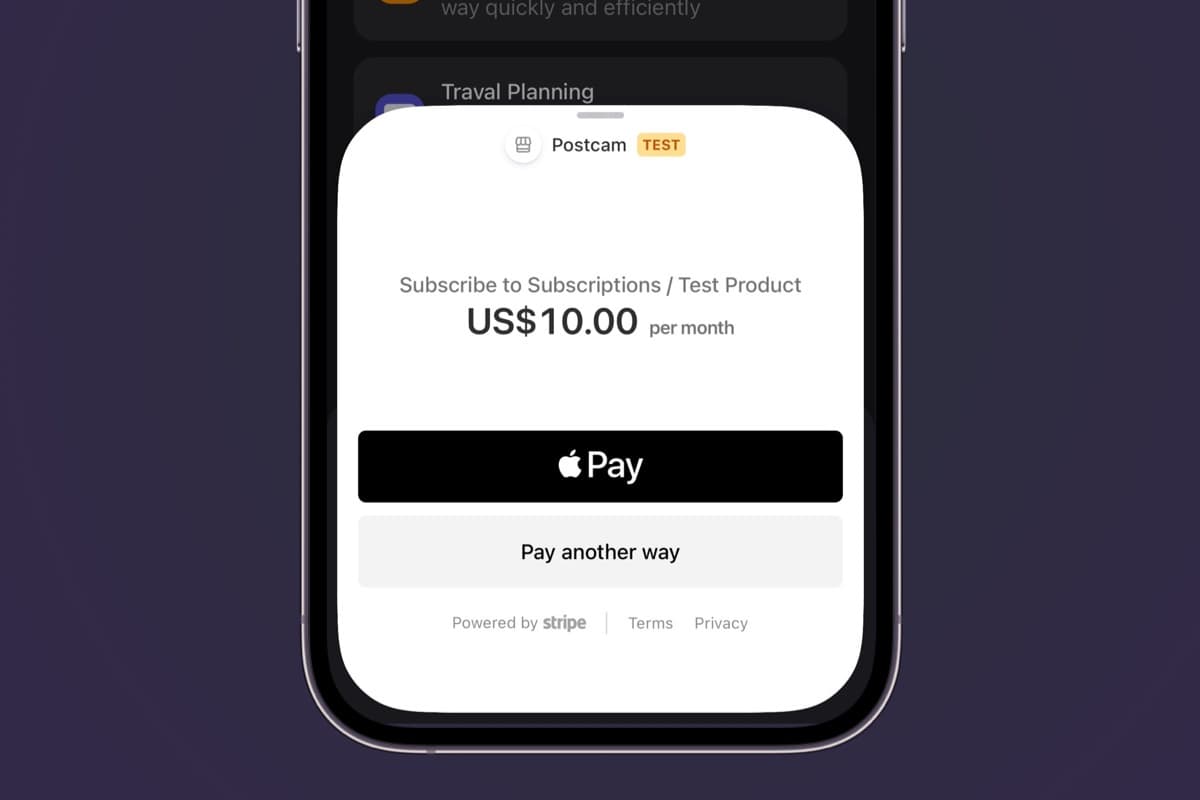 Superwall's Stripe payment sheet in action
Two Checkout Modes
- App-to-web: Tapping a CTA opens a Stripe checkout page in Safari. After payment, a deep link brings the user back into the app.
- Payment Sheet: Stripe's native bottom sheet appears directly in the app, with Apple Pay prioritized for a familiar feel.
Stripe Managed Payments (Merchant of Record)
Pairing Superwall with Stripe's Managed Payments takes this further. In this setup, Stripe acts as Merchant of Record, handling tax collection, fraud prevention, disputes, and chargebacks on your behalf.
This matters more than you might think:
- Lower decline rates. MoR providers benefit from aggregated transaction volume and optimized retry logic, which means fewer failed payments.
- Higher ARPU. Apps using this approach report 10-20% increases in average revenue per user. CalAI is one example already seeing results.
- Faster payouts. You get paid in 5-7 days versus the monthly payouts from app stores.
The Trade-Off: Conversion Rates
There's an important caveat. The Stripe checkout flow is not as seamless as Apple's native in-app purchase sheet. Users are accustomed to the one-tap Face ID confirmation that IAP provides, and any extra friction can lower conversion rates.
However, the revenue you keep per conversion is significantly higher. Even with a modest drop in conversion rate, the net revenue impact is often positive because you're keeping 97% of each transaction instead of 70%.
A/B testing IAP vs Stripe is essential. Run both options and let the data tell you which approach maximizes total revenue for your specific audience.
One more thing to keep in mind: in-app Stripe checkout is currently US-only due to the Epic v. Apple ruling's jurisdiction.
Getting Started
You don't have to pick just one approach. The most effective strategy combines both:
- Use Appfunnel web funnels for global reach and paid acquisition. Every transaction processed on the web completely bypasses the App Store fee.
- Use Superwall + Stripe Managed Payments for in-app US checkout. Give users a native payment experience while keeping your margins intact.
- A/B test App Store IAP vs Stripe to find the conversion and revenue balance that works for your app.
Start capturing more of the revenue you're already earning. The tools exist, the legal door is open, and every month you wait is another 27% left on the table.