LTV Analytics & Attribution
Appfunnel traces every ad click through install to the day-90 breakeven line, builds LTV cohorts and predictions, and fans verified revenue back to the ad networks, so your bidding sees what actually happened after the App Store went dark.
Attribution here starts from money, not pixels: a purchase confirmed against your own processor, matched to its click on the server, and measured in one currency. That is what makes ROAS per cohort and per channel trustworthy in a post-ATT world, and what you feed back to Meta and TikTok so their optimizers chase paying subscribers.
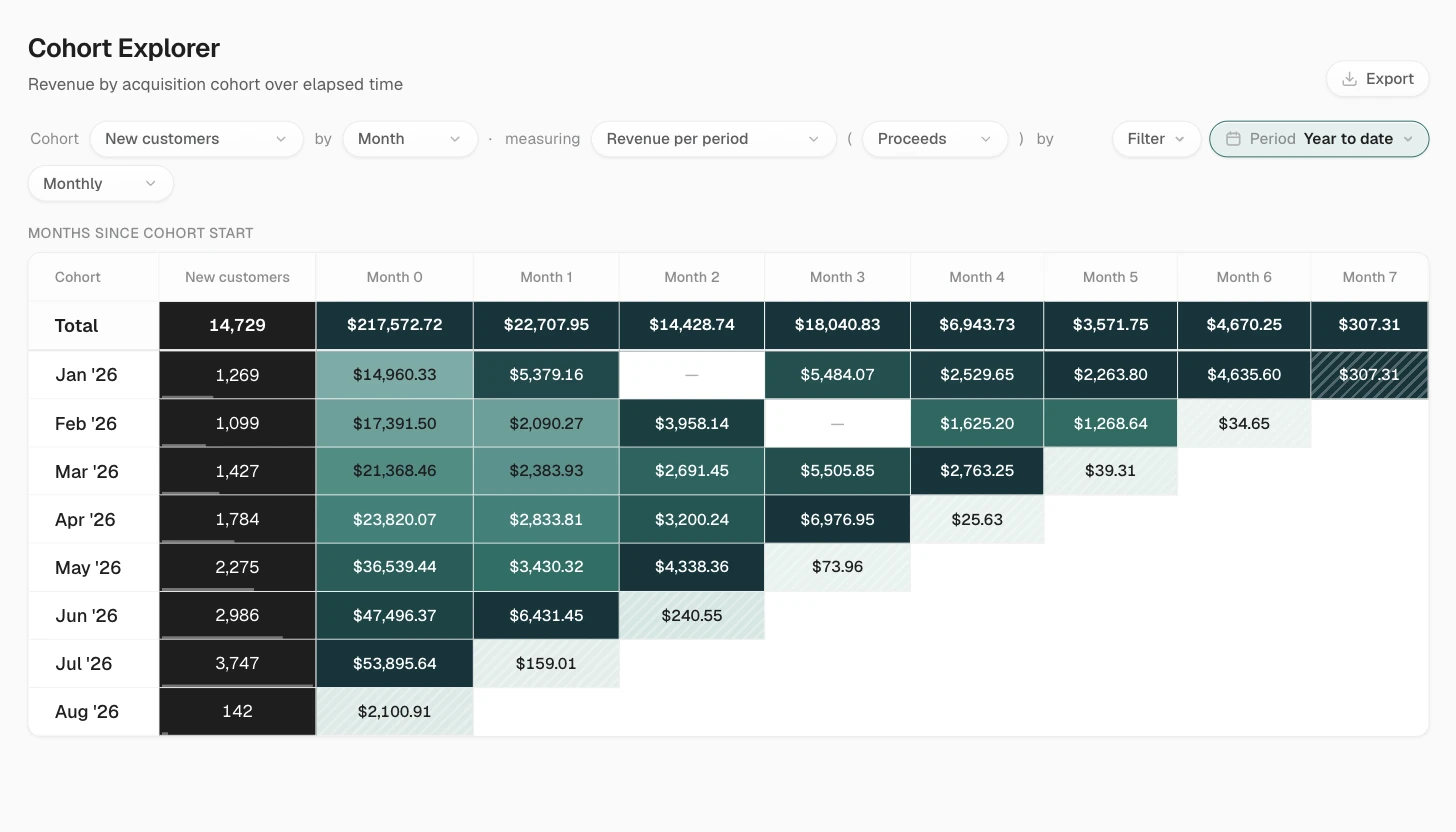
From ad click to day-90 breakeven
A subscriber isn’t worth a fixed number; they’re worth a curve. Appfunnel builds that curve per acquisition cohort and projects it forward, so you know whether a channel pays back before the quarter is out.
Day-90 breakeven. Watch each cohort climb toward the payback line and see which funnels cross it: the number that decides whether a channel is worth scaling.
LTV cohorts, by week or month. Every acquisition week or month becomes a cohort with its own revenue curve, so you compare like with like as curves mature.
Forward predictions. Early cohorts get projected forward from the shape of mature ones, so you can act before 90 days have passed.
One currency, honestly. Revenue is stored in its native currency and in USD frozen at event time, so cross-market cohorts compare on a stable number.
Attribution that survives ATT
ATT blinded the device, not your ledger. Appfunnel attributes from verified revenue on the server, then hands that value back to the networks so their optimizers can still learn.
A revenue event is verified
A purchase, renewal, or refund is confirmed against your own processor, not inferred from a pixel.
It is matched to the click server-side
The event is tied back to the ad click that started the funnel, on the server, where ATT can’t blind it.
It is normalized to USD
Native amount plus a USD figure frozen at event time, so every channel’s ROAS is measured on one scale.
It fans out to the ad networks
Verified value is sent to Meta and TikTok via their conversion APIs, so their optimizers bid on real revenue.
ROAS lands per cohort and channel
The same verified event rolls up into cohort curves and per-channel return you can act on.
ROAS per cohort, per channel
One verified event should answer two questions at once: did this cohort pay back, and should the ad network bid more like it. Appfunnel routes it to both.
ROAS per channel. See return by ad network and campaign, measured on realized revenue rather than platform-reported conversions.
Cohort curves you can trust. Retention, renewals, and refunds roll into each cohort, so a good first week isn’t mistaken for a good cohort.
Server-side CAPI fan-out. Verified revenue, not raw pageviews, feeds Meta’s and TikTok’s conversion APIs, closing the loop ATT broke.
A full subscription suite. MRR and ARR, ARPU and ARPPU, retention, refunds, and a P&L with CAC and margin per channel: the subscription metrics that decide a business, not just a campaign.
Query it, or stream it. Query your analytics (the aggregate charts and cohorts) through the developer platform API, and stream every revenue event to your own warehouse or stack over webhooks.
Where teams use it
Decide what to scale
Compare day-90 breakeven across channels and put budget behind the cohorts that actually pay back.
Feed the optimizers real value
Send verified revenue to Meta and TikTok so their bidding chases paying subscribers, not cheap clicks.
Catch a bad cohort early
Read the projected curve weeks before payback and cut a channel before it drains the budget.
Compare markets fairly
Hold every cohort to one USD scale and see which country genuinely earns its acquisition cost.
Questions, answered directly
What is the “day-90 breakeven” you keep referring to?
It’s Appfunnel’s framing for the moment a cohort’s cumulative revenue covers what you paid to acquire it. We treat roughly the first quarter as the window where most of year-one LTV lands, so day-90 is the line we watch. It’s our own benchmark, not a figure from any industry report.
How does attribution survive Apple’s ATT?
By working from verified revenue instead of device pixels. Appfunnel confirms each purchase against your own processor, matches it to the originating ad click server-side, and sends that value back to the networks through their conversion APIs. ATT limits what a device will report; it doesn’t limit what your own server already knows.
Which ad networks can you feed?
Meta and TikTok through their server-side conversion APIs today: verified revenue, not raw pageviews. The point is to give their optimizers a real number to bid against, so acquisition chases paying subscribers rather than cheap clicks.
Are these cohorts real revenue or estimates?
Real, verified revenue is the spine: purchases, renewals, and refunds confirmed against your processor and normalized to USD. Predictions are layered on top for young cohorts by projecting from the shape of mature ones, and they’re labeled as projections, never mixed into the realized number.
Can I get this data into my own stack?
Two ways. The API exposes your analytics, the aggregate charts and cohorts you see in the dashboard, so your own dashboards can read them programmatically. And every raw revenue event streams to your own stack over webhooks, so you can land the events in your warehouse or models yourself.
Related features
A/B Experiments
Read every variant on conversion, ARPU and revenue per payer; the winner is decided on realized revenue.
Payments & Billing
The verified purchases and renewals these cohorts are built from.
AI Web Builder
Build the intent-matched funnels whose cohorts you’re measuring.
Subscription Management
The entitlements and access states behind these subscription cohorts.
Developer platform
Query your analytics via API; stream every event to your stack over webhooks.
Measure to day-90. Bid on revenue, not clicks.
Trace ad-click to breakeven and feed verified revenue back to the networks: free for 14 days.