Payments & Billing
Appfunnel’s payments layer lets a web-to-app funnel take money the day it launches. You connect your own provider — Stripe, Paddle, Whop, SolidGate, or Primer — mount a checkout inside your page, and keep every customer and every payout. Then reach for payment orchestration to route, retry, and recover charges once one processor stops being enough.
It is plug-and-play first: a paywall with wallets and cards, trials, one-click upsells, and winback, with no PCI project to run. The depth is underneath: a provider model that spans PSPs, merchants of record, and orchestrators, so the funnel that works on day one is the same one that scales across processors later.
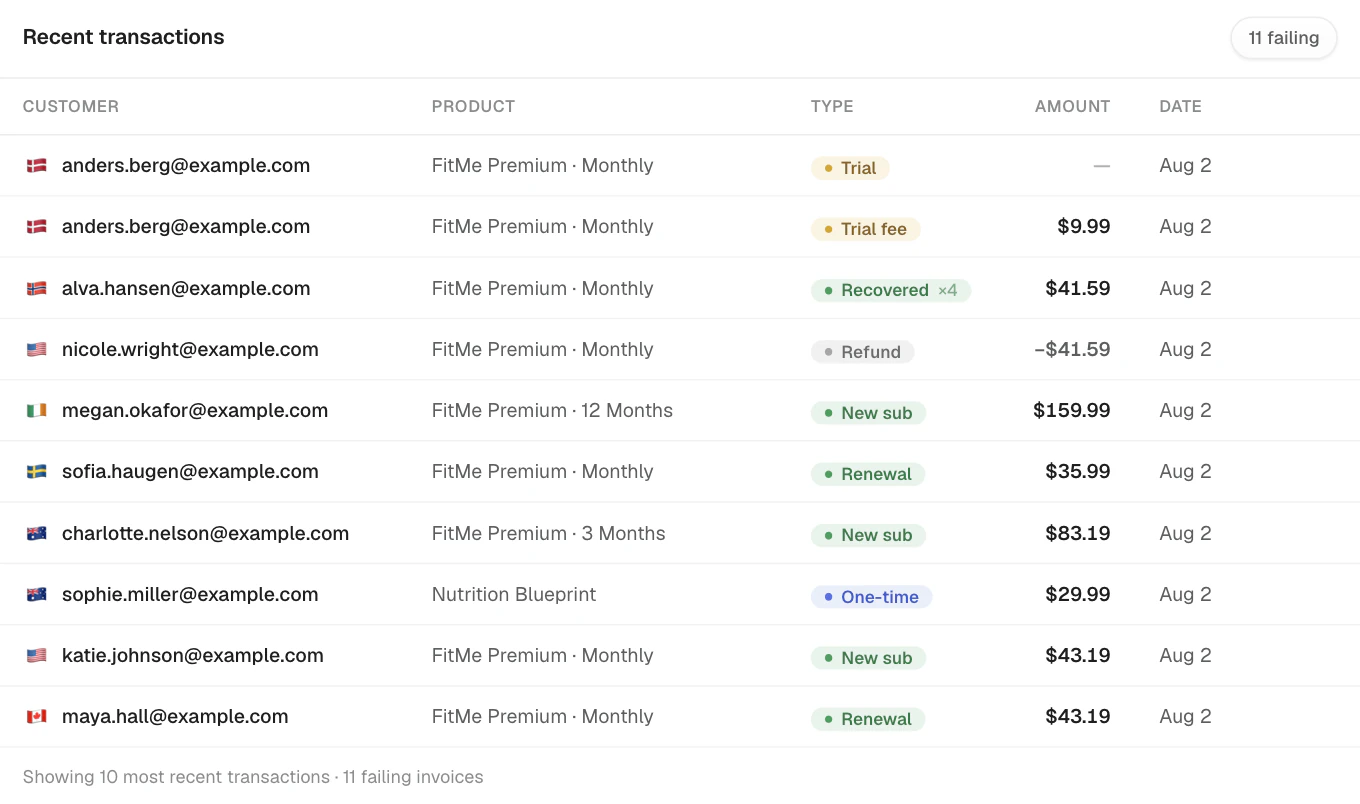
Ship a checkout without building one
You are not building a checkout. You are placing one, with the payment methods your subscribers already expect, in a page you control.
Your own provider. Connect Stripe, Paddle, Whop, SolidGate, or Primer. Settlement, payouts, and the customer record sit with the provider you chose. Appfunnel never becomes the merchant.
Wallets that convert. Apple Pay and Google Pay render as express buttons, the payment method behind roughly 60% of web-to-app transactions. (State of Web2App 2026.)
Real provider SDKs. Stripe Elements, Paddle.js and the rest mount inside Appfunnel’s chrome: the provider’s own fields, none of your PCI scope.
Per-product pricing. Each page points at one of your products, priced in the buyer’s currency and stored native plus a USD figure frozen at the time of sale.
Payment orchestration, when you outgrow one processor
Between 30% and 50% of initiated web payments fail: 3DS friction, declines, missing wallets (State of Web2App 2026). That is not a demand problem; it is an infrastructure one, and orchestration is the answer to it.
Orchestration treats a charge as routable rather than final. An orchestrator can cascade a declined payment to a second acquirer, carry a portable card token so you are not locked to one processor, and run retries and dunning on a schedule. Two of the five providers do it: Primer, a pure orchestrator that routes across processors you already hold, and SolidGate, which is a PSP and an orchestrator at once: its own acquiring plus connectors across Stripe, Adyen and PayPal.
A subscriber checks out
Wallet, card element, or a managed sheet on the provider you chose, mounted inside your own page.
The charge routes to a processor
A single PSP settles it; an orchestrator can cascade to a second acquirer when the first declines.
A decline routes to a recovery path
onFailed maps each decline category (insufficient funds, expired card, 3DS required) to a recovery page or modal you author. Declarative on-session recovery, live today.
Your processor retries off-session
On the web, Stripe, Paddle, Primer, and SolidGate run the retries and dunning that Apple and Google IAP never allow. The first attempts recover roughly half of what is recoverable; the rest run down over days.
Recovered revenue lands in your account
And the verified event flows on to your analytics and back to the ad networks that sourced it.
Take payments through the providers you already use
Connect any of the five and process the day you launch: a processor you settle through, a merchant of record that owns the tax, or an orchestrator that routes across the acquirers you already hold. The funnel format validates against every provider here, so what you author works on all of them.





One-click upsells, trials, and winback
Owning billing is what makes the growth levers possible. None of them exist inside the App Store’s subscription stack.
Off-session upsells. Post-purchase offers charge the saved method with no re-entry, where the surface supports it: a proven revenue multiplier.
Validated by kind. What is chargeable off-session is provider-specific: Paddle cannot stack a second concurrent subscription, so the builder blocks it and suggests an upgrade or one-time instead.
Trials your way. Free or paid, per plan. On the web, no-trial offers routinely out-earn trials, so you can test that freely.
Recovery IAP won’t give you. On the web with Stripe, Paddle, Primer, or SolidGate you get retries, dunning, and winback at the renewal moments where churn concentrates: the billing tools Apple and Google never expose.
Where teams use it
Launch a paywall this week
Connect Stripe, publish, take Apple Pay. No PCI project, no checkout to build.
Recover failed renewals
On the web your processor runs the retries and dunning that IAP never allows, winning back revenue that was churning silently.
Go global without a tax team
Switch to a merchant-of-record provider and let it own VAT and sales tax.
Outgrow a single processor
Route across acquirers with an orchestrator when volume and approval rates demand it.
Questions, answered directly
Do I need my own payment provider account?
Yes, and that is the point. You connect your own account — Stripe, Paddle, Whop, SolidGate, or Primer — so settlement, payout timing, and the customer relationship sit with the provider you picked. Appfunnel mounts the checkout and reads the events; it never sits between you and your money.
What does payment orchestration actually do?
It treats a charge as routable instead of final. An orchestrator can cascade a declined payment to a second processor, carries a portable card token so you are not locked to one acquirer, and runs retries and dunning on a schedule. Industry data puts retry recovery at up to 17.5% of failed renewals: a 15–20% revenue uplift. (State of Web2App 2026.)
PSP or merchant of record: which do I pick?
A PSP like Stripe or SolidGate settles to your account and leaves tax to you. A merchant of record like Paddle or Whop becomes the legal seller and handles global VAT and sales tax for a higher cut. Appfunnel supports both, and the choice is a setting, not a rebuild. Your funnel and pages do not change.
Can I run one-click upsells, trials, and winback?
Yes. Post-purchase upsells charge the saved method with no re-entry where the surface supports it, alongside free and paid trials and winback offers. What is chargeable off-session depends on the provider: Paddle cannot stack a second concurrent subscription, for instance. The builder validates each combination as you author it.
Aren’t web payments a refund and fraud nightmare?
Less than the reputation suggests. Industry refund rates on web run low single digits (0.2% weekly, 1.8% monthly, 3.7% annual), and about 60% of renewals clear on the first attempt. The real leak is silent decline, not fraud, which is exactly what retries and routing address. (State of Web2App 2026.)
What does this cost versus the App Store?
You pay your processor’s normal rate plus Appfunnel’s 2% of proceeds. Call it 2–5% all-in against the App Store’s 30%. The fee saving is real, but it is the kicker, not the pitch: owning billing is what unlocks retries, upsells, and per-country pricing in the first place.
Related features
AI Web Builder
Describe pages, preview on a phone, publish. Real React underneath.
LTV Analytics & Attribution
Ad-click to day-90 breakeven, with revenue fed back to the ad networks.
A/B Experiments
Test one page or a whole funnel, four variants at a time; Appfunnel tells you when you have a real winner.
Subscription Management
Turn those purchases into entitlements that gate your app by access level.
Developer platform
The SDK, CLI, and agents underneath the builder: the power ceiling.
Take payments the day you launch. Orchestrate them when it pays off.
Connect your own Stripe, publish a paywall, and keep the customer relationship: free for 14 days.